
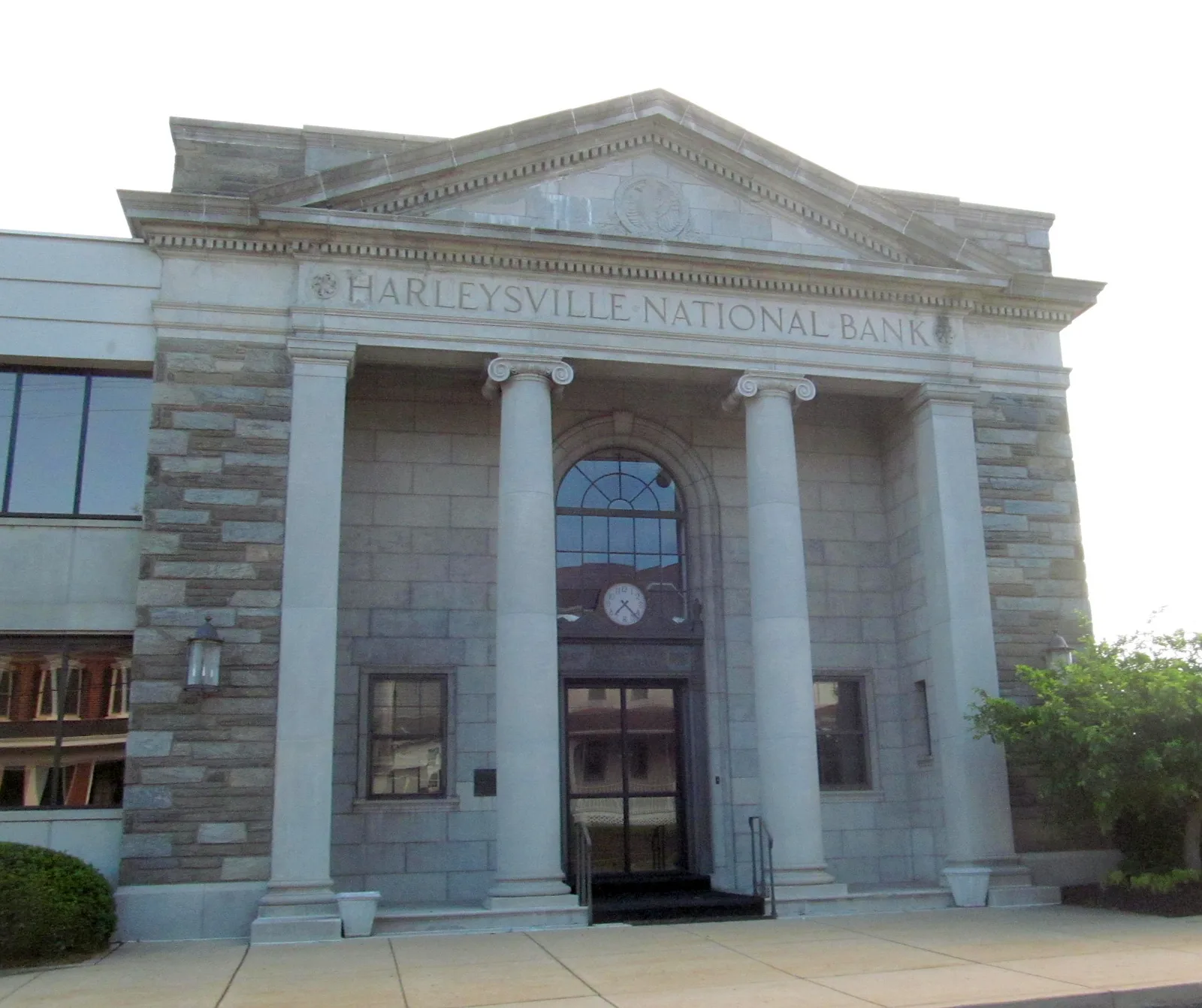
House Painters in Harleysville, PA
Harleysville, in Lower Salford Township, is where Montgomery County farmland became subdivisions. The result is two completely different housing markets sitting side by side: colonials from the 1990s and 2000s on curved streets, and the farmhouses, springhouses, and bank barns that were there first and are still standing.
We work both, and they could not be less alike.
The subdivision stucco bracket
The newer homes here fall squarely into the era where suburban stucco moisture failure is concentrated. Houses built roughly 1993 to 2006 across this region are the highest-risk group, and a frequent cause is that drain screeds were omitted at the base of the walls, leaving trapped water no way out.
Because the damage happens to sheathing and framing behind the wall, it does years of work before anything shows on the face. Cracking that follows a pattern, staining below windows or at wall bases, soft spots, or bulging are the signals worth taking seriously together.
We paint and repair sound stucco and apply elastomeric where a wall needs a flexible membrane over hairline cracking. We do not coat a wall showing intrusion signs.
Old farmhouses, and what they ask for
The surviving farmhouses here are a different century and a different discipline. Thick masonry walls, plaster interiors, deep window reveals, and exteriors that in many cases have been stuccoed or parged over stone.
Masonry has to breathe. Sealing an old stone or parged wall with a modern film-forming exterior traps the moisture the wall has always managed to release, and it pushes the coating off, sometimes taking the parge with it. These walls want vapor-permeable products, and the older the building the more that matters.
Interiors are plaster over lath and are frequently worth repairing rather than replacing, because a properly restored plaster wall reads correctly in a house like this in a way drywall never will.
Bank barns and outbuildings
This township still has real barns, and painting them is work almost no one here quotes.
A bank barn is large, high, and usually a mix of stone foundation, wood siding, and a metal roof, which means three substrates on one structure. Wood gets scraped, primed, and finished, generally sprayed given the scale. Metal roofing gets rust taken back, treated, primed with a metal-specific primer, and coated with something that handles the thermal movement a metal panel goes through. Stone foundations get left alone or treated as masonry.
Springhouses, equipment sheds, and pole buildings fall under the same work.
Kitchens in the newer homes
Colonials from this era have large kitchens with long runs of solid oak, maple, or cherry cabinetry, and those refinish extremely well.
The boxes are usually better built than an equivalently priced replacement, the layout typically works, and the complaint is almost always the finish rather than the function. A full refinish runs about a week with the kitchen usable through most of it. See cabinet painting and wood finishing.
Thermofoil doors are the exception. The vinyl skin peels off the fiberboard and paint does not correct it.
Common Questions
Do you paint barns?+
My 1999 colonial has stucco cracks. Is it serious?+
Can you paint my old stone farmhouse?+
Is my oak kitchen worth refinishing?+
Our Services Here
Nearby Areas We Serve
Serving Harleysville, PA.
Free written estimate in Harleysville and Lower Salford. Call Ed at (267) 446-1862. ---