Painting Cabinets vs Replacing Them: What Philadelphia Kitchens Should Know
A kitchen renovation is one of the largest discretionary expenses a homeowner takes on, and cabinetry is the biggest line in it. Refinishing what is already there costs a fraction of replacing it.
Whether that is the right call depends entirely on one question, and it is not the question most people ask.
The question that actually decides it
It is not "are my cabinets old." It is "what do I dislike about my kitchen."
If the answer is the color, the finish, the dated stain, or the general tiredness of it, refinishing solves the entire problem.
If the answer is that there is nowhere to put anything, the layout does not work, or the island is in the wrong place, no finish on earth fixes that. Refinishing a kitchen you dislike the shape of leaves you with a kitchen you still dislike the shape of, in a nicer color.
Ed will ask you this at the walkthrough, and if the honest answer points toward replacement, he will say so.
Which cabinets take a finish well
Good candidates. Solid wood doors and face frames. Plywood boxes. Sound joinery and hardware. Older Philadelphia-area kitchens are frequently solid oak, maple, or cherry, and those refinish beautifully. In many cases they are better built than an equivalently priced replacement would be.
Poor candidates. Thermofoil doors, where a vinyl skin is heat-wrapped over fiberboard. The skin peels away from the substrate and paint does not correct that. Particle board boxes that have swollen from a leak under the sink are past saving. Doors that are delaminating or seriously warped need replacing.
Anybody who tells you every cabinet can be refinished is selling rather than assessing.
What a proper cabinet job actually involves
The difference between cabinets that look factory finished and cabinets that look painted is entirely in the preparation.
Degrease first. Kitchen cabinets carry a film of cooking grease that sanding alone does not remove and that will reject a finish. This step gets skipped constantly.
Hardware off, doors off. Doors and drawer fronts come off, get labeled, and get finished away from the boxes. Hardware comes off rather than getting taped around.
Sanding. Not to bare wood necessarily, but to a uniform, deglossed surface that a primer can grip.
Bonding primer. Matched to whatever the existing finish is, or to bare wood if it has been stripped.
Thin, even coats. Laid down light and built up, not loaded on. Thick coats are what produce brush marks, sags, and a finish that stays soft.
Cure time before rehanging. Rushing this is why doors stick to frames and hardware leaves impressions.
How the timelines compare
A cabinet refinish on a typical kitchen runs about five to eight working days, and the kitchen stays usable for most of it because the doors are being finished elsewhere.
A full cabinet replacement is weeks, and for a good part of that the kitchen is not a kitchen. There is demolition, there is usually countertop work, and there is frequently a delay waiting on a delivery.
For a lot of households that difference matters as much as the price does.
The honest limits of refinishing
Refinishing does not add storage. It does not change door style, though hardware changes make more visual difference than people expect. It does not fix a bad layout, move a sink, or correct cabinets that were badly installed in the first place.
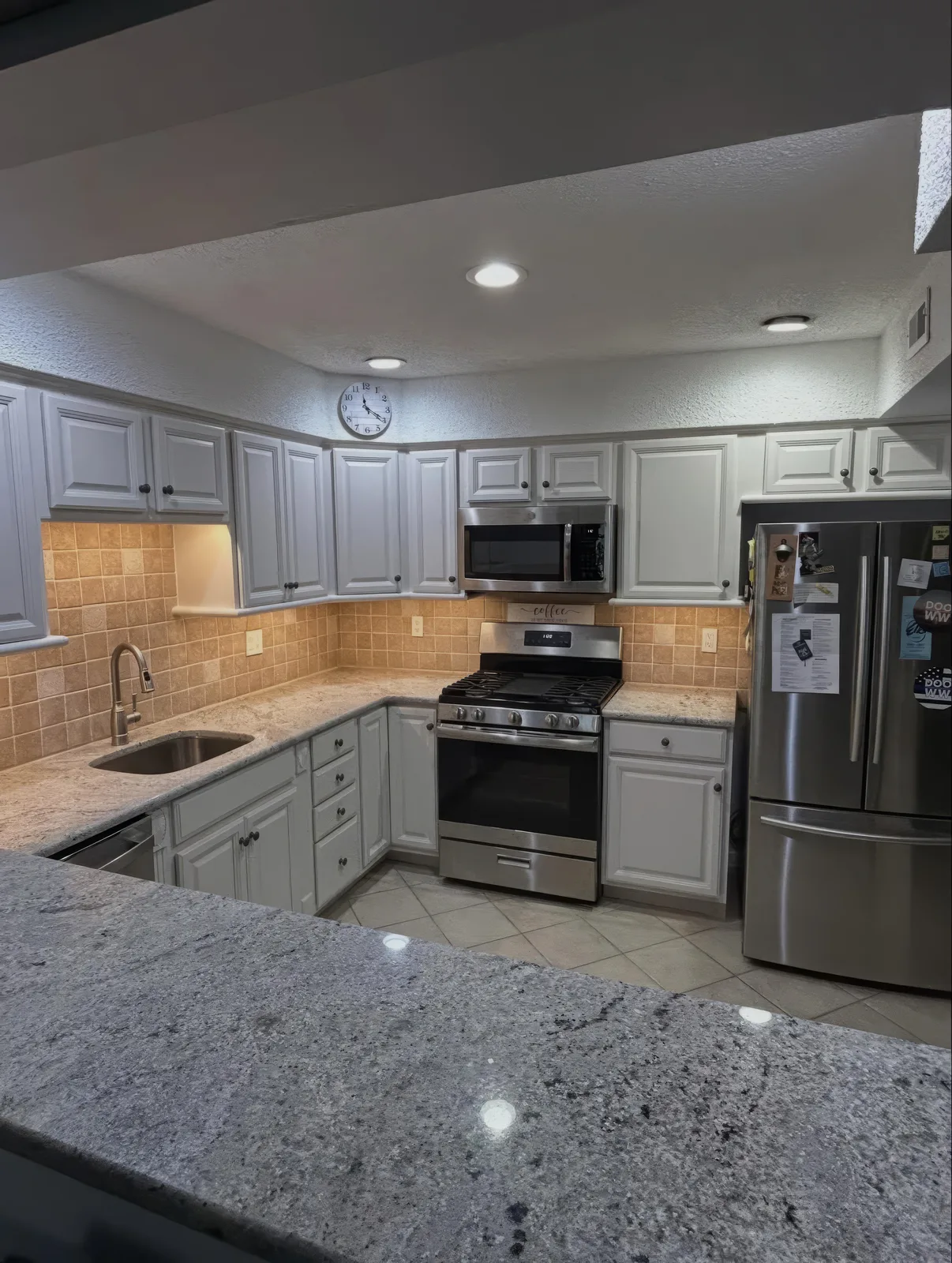
What it does is take a sound kitchen that looks dated and make it look current, for a fraction of the cost and in a fraction of the time.
Hardware makes more difference than people expect
If you are refinishing rather than replacing, hardware is the cheapest change with the largest visual return, and it is worth thinking about before the doors come off.
Swapping knobs for pulls, or going from small dated knobs to longer modern pulls, changes the read of a kitchen more than most people anticipate. Because the doors are already off and labeled during a refinish, it is also the easiest possible moment to do it. New holes get drilled and old ones get filled and finished while everything is off the boxes, which is far cleaner than doing it later.
The one thing to check first is hole spacing. Existing pulls have a fixed center-to-center measurement, and matching it means no filling at all. Changing it means every door and drawer front gets filled and refinished, which is not a large cost during a refinish but is worth knowing about in advance.
Hinges are the other item. If your existing hinges are surface-mounted and visible, replacing or refinishing them matters as much as the cabinet color does.
Keep reading
Cabinet painting and wood finishing and interior painting in Horsham, Philadelphia, and across 29 towns. Free estimate at (267) 446-1862.