Scope of work
Commercial and multi-family work
We take offices, retail spaces, common areas, hallways, stairwells, apartment buildings, and mixed-use properties across Philadelphia and the surrounding counties.
Commercial work is a different discipline from residential. The surfaces are usually larger and simpler, but the constraints are tighter: access windows, occupied tenants, insurance requirements, and a hard finish date that somebody else's lease depends on. Ed has been running these jobs since 2004, after painting since 1999, and quotes them the same way he quotes a house, in writing, with the prep priced separately so you can see what is going into it.
Philadelphia's lead rules and what they mean for landlords
If you own pre-1978 rental property in Philadelphia, this is worth reading carefully.
Philadelphia's Lead Paint Disclosure and Certification Law requires owners of properties built before 1978 to provide a lead-safe or lead-free certification in order to sign or renew a lease and to obtain or renew a rental license. Since April 1, 2022 this applies to every pre-1978 rental in the city, not only units with young children in them, and certification has to be renewed on a set schedule.
Here is the part that matters to a painter. A lead-safe certification requires the property to be free of deteriorated, flaking, chipping, peeling, or chalking paint. Failing that is a paint condition problem, and it is fixable. Getting ahead of it before an inspection is far cheaper and far less disruptive than scrambling after a failed certification with a lease date coming.
Given the age of Philadelphia's housing stock, most rowhome rentals in this city are in scope. We work with owners and property managers to get units into condition ahead of certification and to keep them there between tenants.
One important note: we are painters, not lead inspectors. The certification itself has to be issued by a certified lead dust sampling technician or a licensed inspector. Confirm the certification requirements for your specific property with the City, and confirm any lead-safe work practice requirements before disturbing paint in a pre-1978 building.
Rental turnovers on a schedule
Turnover work lives or dies on timing. A unit that sits an extra week is a week of lost rent, and a painter who does not show up on the day he said is the reason it sits.
We schedule turnovers around lease dates, work vacant units fast because there is nothing to move or protect, and handle the repair work that turnovers always turn up: nail holes by the dozen, patched-over anchors, damaged drywall corners, and bathroom ceilings that need more than a coat.
For owners with multiple properties we can run a recurring schedule rather than quoting each unit cold every time.
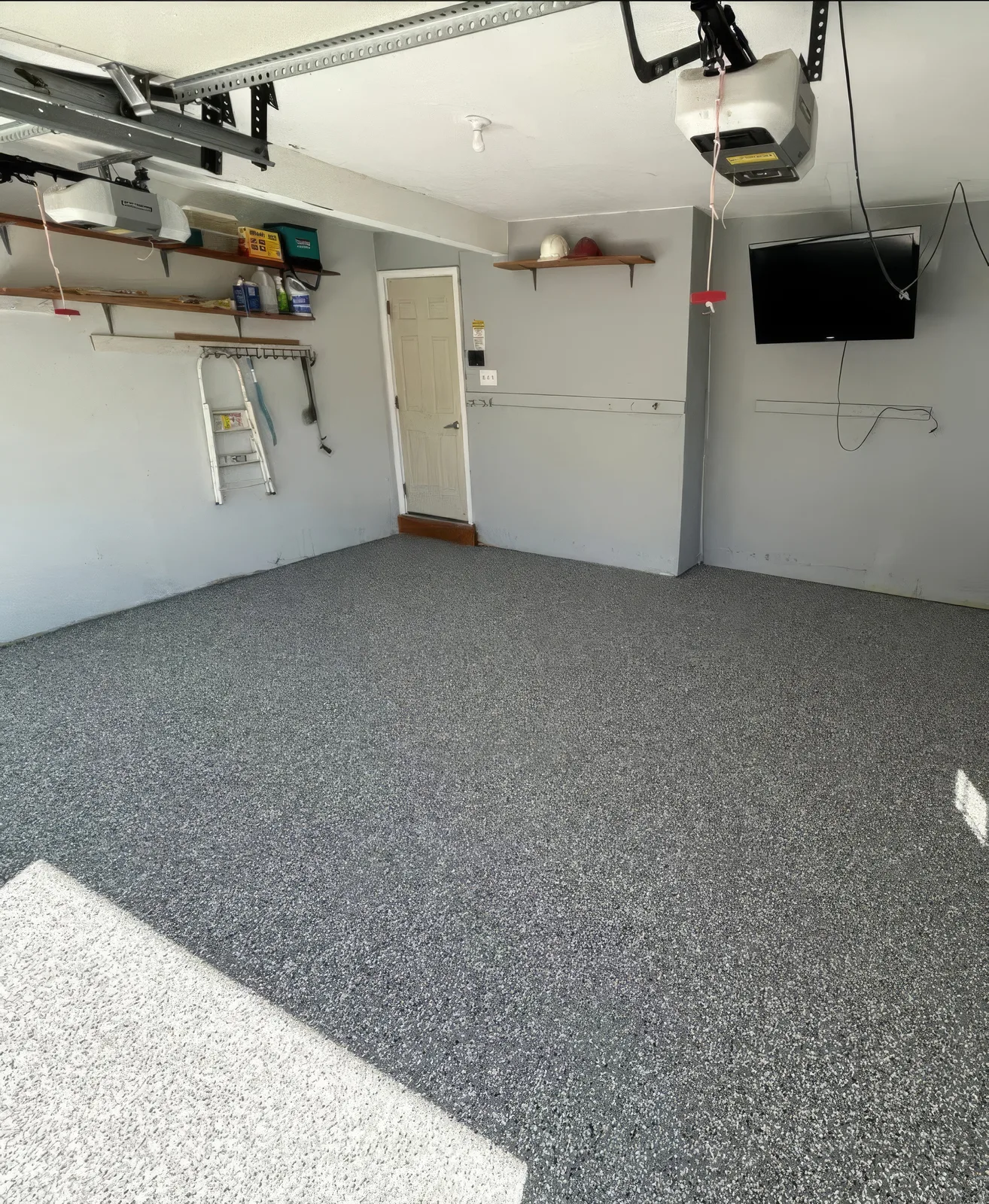
Epoxy garage floors with flake
This is a service Ed specifically called out and it is one of the most requested specialty coatings we do.
A flake epoxy floor is a multi-layer system, not a paint. The concrete has to be mechanically profiled first, usually by grinding, so the coating can key into the slab. Any oil contamination has to come out, and cracks and spalls get filled. Then the base coat goes down, the flake is broadcast into it while it is wet, the excess gets scraped and vacuumed, and a clear topcoat locks the whole thing in.
Done that way it holds up to hot tires, road salt, and dropped tools. Done as a one-part epoxy paint rolled onto an unprepared slab, which is what the kits at the box store are, it peels up with the first set of tires that parks on it in July.
Garage floors, basements, workshops, and light commercial floors are all candidates.
Elastomeric coatings for walls that move
Elastomeric is a thick, flexible, high-build coating that bridges hairline cracks and moves with the wall instead of splitting when it does. It goes on far heavier than paint and is measured in mils rather than coats.
It has a real place, mostly on stucco, masonry, and concrete block that has hairline cracking but is otherwise sound. It is common on the stucco homes throughout the Philadelphia suburbs and on block commercial buildings.
It also has a real limit, and this is the part that gets ignored. Elastomeric is vapor-restrictive. On a wall that is actively taking on water from behind, it seals the moisture in and makes the underlying problem worse while hiding it. It is not a fix for a leaking wall. Ed will tell you whether your wall is a candidate or whether you have a moisture intrusion problem that needs to be solved before anything is coated.
Working around a business that stays open
Most commercial customers cannot close, so we work around that.
That means nights and weekends where the space demands it, phased work so only part of a floor or a hallway is down at a time, low-odor products in occupied spaces, and keeping egress paths and exits clear and compliant while we work. Materials get stored and secured rather than left in a public area.
Tell us the constraint at the walkthrough and the schedule gets built around it.
How commercial jobs are quoted
Commercial pricing turns on access, height, occupancy, and finish schedule.
Off-hours work costs more per hour and is often still the cheaper option overall, because it removes the disruption cost. Stairwells and high ceilings need lifts or staging. An occupied building requires more protection and more setup and breakdown per day than a vacant one. Multi-unit and recurring work prices better than one-off jobs.
Ed does the walkthrough personally, and the estimate comes back in writing with a schedule attached.
How the Job Runs
- 01
Walkthrough with the owner or property manager, including access and hours constraints.
- 02
Written estimate with prep, materials, and schedule broken out.
- 03
Protection and staging around occupancy.
- 04
Prep and repair, then the coating system specified for the surface.
- 05
Final walkthrough and punch list sign-off.
Frequently Asked Questions
Do you work with property managers on multiple buildings?+
Yes. For owners and managers with several properties we set up a recurring turnover schedule instead of quoting each unit from scratch.
My Philadelphia rental is pre-1978. Can you get it ready for lead certification?+
We can get the paint condition right, which means addressing deteriorated, flaking, peeling, and chalking paint. We are not lead inspectors and we do not issue certifications. Confirm the specific requirements for your property with the City, and confirm any lead-safe work practice rules that apply before paint is disturbed.
How is a real epoxy floor different from the kit at the hardware store?+
The prep and the system. A proper floor is mechanically ground so the coating keys into the slab, contamination is removed, cracks are filled, then a base coat, broadcast flake, and a clear topcoat. Box store kits are one-part paint rolled onto an unprepared slab, and they lift with the first hot tire.
Is elastomeric coating right for my stucco?+
Sometimes. It is excellent on sound stucco or block with hairline cracking. It is the wrong answer on a wall that is taking on water from behind, because it seals the moisture in. Ed will look before recommending it.
Can you work nights or weekends?+
Yes. Most of our occupied commercial work happens off hours. It costs more per hour and usually saves the customer money overall by removing the disruption.
Do you do exterior work on commercial buildings?+
Yes, including masonry, block, stucco, and metal. See [exterior painting](/services/exterior-painting) for how we handle each substrate.