Wallpaper Removal in Philadelphia Rowhomes: What to Expect
Wall scraping is in our company name, and Philadelphia is the reason. This city has more layered wallpaper hung over unprimed plaster than anywhere else we work, and homeowners are consistently surprised by what comes off the wall with it.
This is what actually happens when the paper comes down.
Why there is so much of it here
Philadelphia's rowhomes were largely built between 1890 and 1930, and wallpaper was the standard wall treatment for most of that period and for decades afterward.
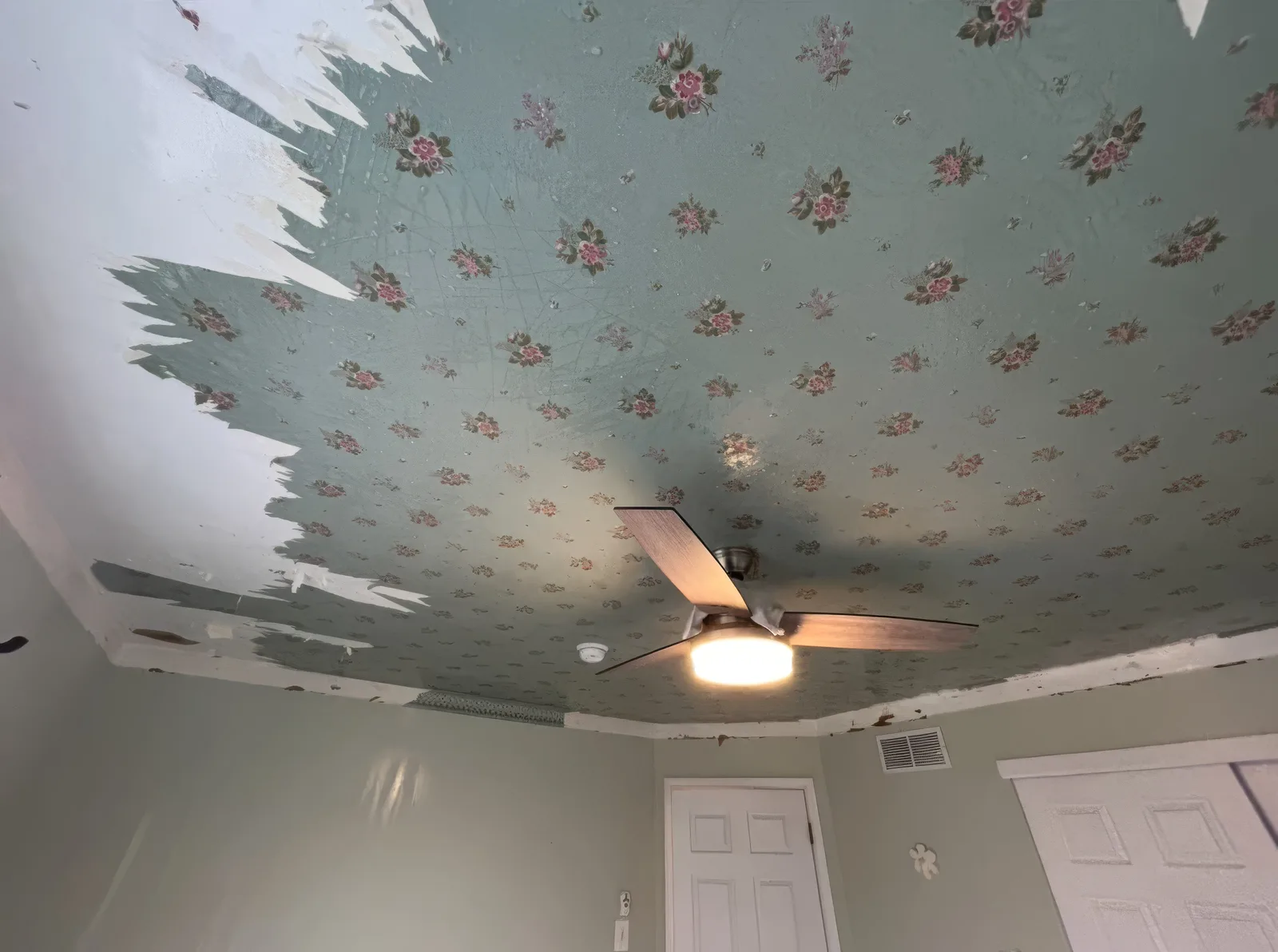
That means a typical house has been papered more than once, often with each new layer going straight over the last. Somewhere along the way somebody got tired of it and painted over the whole thing, which is why so many walls in this city have paper hiding under a coat of latex.
Each of those decisions made sense at the time. They just compound.
What we find underneath
Almost always some combination of the following.
Multiple layers. Two is common, three is not unusual, and we have found more.
Paper hung on unprimed plaster or drywall. This is the difficult one. Without a primer between them, the adhesive bonds directly into the surface, and on drywall the paper face and the drywall's own paper facing effectively become one thing.
Cracked plaster. Century-old plaster on wood lath cracks over openings, along the ceiling line, and at the party wall. Paper was often hung to hide it.
Blown sections. Plaster that has separated from the lath and moves under hand pressure. Nothing will hold a finish there until it is re-anchored or replaced.
Moisture damage. Party walls and north-facing walls dry slowly in this city. Where a wall has been holding damp, the plaster behind the paper is usually soft.
How the paper actually comes off
The method follows the paper and the substrate, not a preference.
Older uncoated paper on well-primed plaster usually releases with hot water from a garden sprayer and patience.
Vinyl and coated papers have to be scored first so moisture can reach the adhesive. Scoring needs a light hand, because pressing hard puts a grid of gouges into the plaster that then has to be skimmed out.
Steam is the correct tool for stubborn multi-layer work, and it is also the fastest way to ruin drywall if it sits in one place, because the moisture drives straight through to the gypsum core.
The adhesive is the part people miss
Getting the paper off does not get the paste off, and this is where nearly every homeowner attempt falls apart.
Old adhesive has to be washed off the wall completely. If it stays, primer will not bond to the surface, and the entire new finish ends up sitting on a layer of dried glue. It looks fine for a few weeks and then starts lifting.
Half the rooms we get called into are ones somebody else already started, and the paste is usually still on the wall.
What happens after the wall is bare
The wall gets repaired, and then it gets skimmed.
Repair means cutting cracks back to sound plaster, taping and bridging them with setting compound, feathering wide enough that the repair does not telegraph, re-anchoring or replacing blown sections, and cutting out anything soft from moisture.
Skimming means a thin coat of compound across the entire surface, sanded flat, so the wall reads as one continuous surface rather than a patchwork of repairs. This is what matters in a room with a window on one wall and a lamp on the other, because raking light finds every high and low spot a spot-patched wall still has.
Then a proper primer, then paint.
How long it takes
A single room in reasonable condition is often one to two days including repair.
A full first floor of a 1915 rowhome with layered paper and cracked plaster can run most of a week, and most of that week is repair and skim coating rather than stripping.
Anybody quoting a whole floor of an old rowhome as a two day job has not looked behind the paper.
When paper can stay
Occasionally it can. If the paper is a single uncoated layer, tightly adhered everywhere with no lifting seams, hung over a primed surface, and there is no sign of moisture, it can sometimes be sealed and skimmed rather than removed.
That is the exception. Ed will tell you at the walkthrough which situation you are in, usually by testing a corner, rather than guessing from a photo.
Keep reading
Wallpaper removal and wall restoration and interior painting across Philadelphia and the surrounding counties. Free estimate from Ed at (267) 446-1862.